First thing Saturday morning I was back on highway One, leaving behind the American Colony Hotel and all its luxury. Sabbath had begun so traffic was lighter, similar to a typical Canadian weekend. Most Israeli’s simply aren’t that devout. There are areas of Jerusalem where the ultra-orthodox will stone your car if you drive on the Sabbath, but the orthodox remain a minority, and typically keep to their own areas. Despite all of the their indignation at Sabbath driving, it’s not easy getting out to throw stones at cars on the highway when you have to walk the whole way. Sometimes the universe appreciated a bit of irony.
The first military checkpoint is just east of Jerusalem, and for what matters, this is where the West Bank really begins. For the first time a new type of car appears on the road, one with green plates with a distinctive “P” on the left side. It’s a not so subtle way of telling you that this car belongs to a Palestinian from one of their West Bank enclaves. Without that plate, however, you might never know. For the most part it seems Palestinians who can work through the red-tape to get access to the Israeli roads within the West Bank, also have access to funds. The cars are new and well kept.

Leaving Jerusalem drops you into another world. It is the line between the semi-arid, but still productive center of the country, and the barren wasteland of the Judean desert. Hot, bleak, oven like. As many adjectives as you can think to describe heat, this place can use. The scenery is spectacular, particularly if you hate green. Nearer the Dead Sea there are signs warning of road closures due to floods. Locals here assure me that flash flood are a real danger, and there are even photographers who go out into the desert to chase them down, but it’s hard to believe when all you see is an endless expanse of rock and heat.
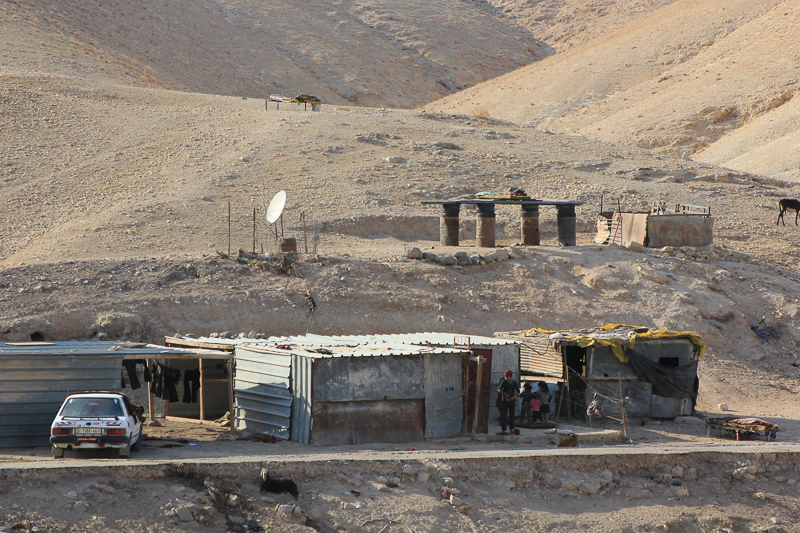
Not far from Jerusalem you see the first Bedouin. But these aren’t the Bedouin of movie fame. You aren’t about to see Omar Sharif offering you figs from the comfort of a colorful tent. These Bedouin look as though they’ve survived a nuclear strike, eking out the most meager existence, their homes clinging to the sides of hills. These are makeshift structures of corrugated steel and other bits they’ve scavenged. Nearby, their herd of goat manage to subsist on the barren scrublands. And then before you know it the Bedouin are gone too, the climate too harsh even for them, and there is nothing left but rock and the occasional military radio mast atop the hills.

My goal for the day was Masada, built by Harod around the time of Christ, and later the scene of the mass suicide of the last Jewish Zealots fighting off the Roman Legions. For years the Israeli army did their swearing-in ceremony here, until someone realized that perhaps the glorification of mass religious suicide wasn’t the best model for an army with a goal of actually winning a war. Driving towards Masada, on the west you have a line of desolate red mountains, and to the east the Dead Sea. It is the only body of water I’ve ever seen that has no plants on its shores. Nothing. The landscape is utterly, and totally dead.
Having had huge expectations I was surprised when I finally reached it. I had expected a single grand monolith like Ayers rock in Australia. It’s not. It’s just one of many burnt red mountains that are part of the long line I’d been driving next to for an hour. It’s tall enough that at first I didn’t even realize it was Masada. Unless you look closely you don’t see the tiny trail that winds up the east face or the ruins atop the mountain. Either the climate really has changed dramatically, or Harod was a madman to build a palace out here. Its total isolation must have been a reason it fell out of use so quickly once he died. And my god it was hot.
I had planned to hike the Snake path, the original trail used by Masada’s inhabitants. On a good day in the winter it can take a couple of hours to climb. Today, one of the hottest days in the year, it was going to be a nightmare. Groups stood about in the air conditioned visitors center, slathering on sunblock, getting their water ready, buying specialty hats, all in preparation for the arduous trek up ten stairs to the gondola. The gondola? Cowards. Ready for anything, I marched passed them feeling rather superior, got out to the trail head and stopped. Close due to extreme heat. Damn it. In hindsight, this was a very good thing. A Danish cyclist died that day from the heat. No doubt I would have as well.

The gondola ride up is actually rather nice, and a good way to go if you’re not a fan of heat stroke. Still, there are two sides to Masada. I was on the eastern side which has the Snake path which can be closed because you can take the gondola instead. On the western side there’s the Roman siege ramp, but no gondola, so they can’t very well close that one, can they? Anyone coming from the west has to climb the mountain. So once at the top I spent a bit of time looking up at the sun and sweating, then walked around to the western side and headed down the path to the mountain’s base. I had come to Masada to climb it, and damn it I was going to climb something even if that meant going down the wrong side first.
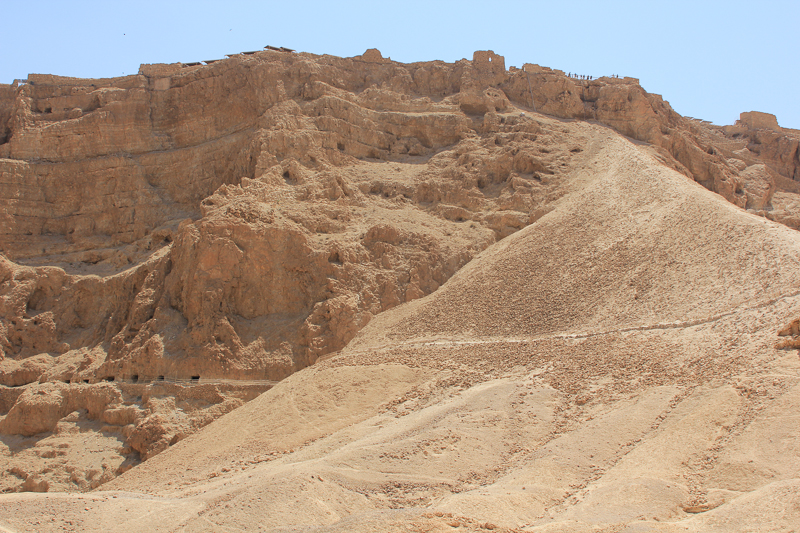
Other than the incredible location, Masada is famous for the 700 Zealots who committed suicide rather than be taken captive or killed by the Romans. Because the Romans couldn’t possible attack by way of the perilous Snake path, to get to the top they simply built the mother of all ramps and wheeled up their battering rams. This is why Rome conquered the world. No one could compete with that. Today, the siege ramp, a containment wall, and numerous siege camps are all still laid out around the mountain where the Roman left them over 1,900 years ago. It was a remarkable place to explore, and I did it entirely alone. The entire time I was there I could count the number of people who climbed that siege ramp on one hand with all the fingers hacked off. There was nothing alive except ravens, and I’m lucky they weren’t vultures. They would have seen me wandering down along the siege wall, nearly a kilometer from any source of shade, and pecked out my eyes. At some point my brain kicked in, I turned around, and started the trek back up. It was head down, one foot and then the other. There was a good reason the Snake path was closed. Once aback atop, although climbing up the Snake path was forbidden, I realized that climbing down was not, so that’s how I returned to the absolute bliss of the visitors center, and it’s popsicle sales woman to whom I quickly became a regular. The moment my body heat that cold, air-conditioned air, my sweat stopped evaporating and I was drenched.
When Masada fell to the Romans, it was abandoned almost immediately. Much of what was there was left in place, including human remains. While leaving the onsite museum the attendant asked me what I found most interesting. For him it had been eleven clay port shards, each with a man’s name on it…without question in his mind the famous lots the Zealots had drawn to see who would kill the 700 others, and then commit suicide himself. Lovely group, Zealots. Historically interesting, sure, but the find seemed just a little too prosaic to be believed. What really caught my attention was a braid of woman’s hair, as though just recently cut. Very moving. One of the wives of the Zealots, says the museum. More likely a Roman woman captured and killed when the Zealots first seized the place, say modern archeologist. And the Zealot remains who were given full military burial by the Israeli army? Likely Roman soldiers from the original garrison. It’s good that they all agree.
That was the further point south I went. From there I headed back northwards.
It’s no longer accurate to call it the Dead Sea. The sea level is dropping a meter a year, and has now broken into two distinct sections. What a wonderful environmental disaster it has become, and a great spot to stop for a bit of a swim. I halted at a place near Ein Gedi, which also had a true desert oasis which I completely missed because I was too intent on watching Russian matrons float like Beluga. For man of the Russians, the real joy here was they could float and smoke at the same time.
From Ein Gedi’s original beach area you have two options to get to the sea. You can walk to the new shoreline, or take a makeshift train. It’s the sort that drags families around amusement parks. When you’re standing at a sign that says “Shoreline: 1985” it seems silly to do anything but walk, so I did. It seemed even hotter there than at Masada, but I was going to a beach, and planned to cool down in the water. After baking under the sun for about ten minutes I came to a well-constructed wooden deck that at some point had been the new beach area. No signs of water. I kept going. I came to a shower facility used to get the salt off your body when you’re done swimming. I kept going. I passed a sign that said “Shoreline: 2000”. See where this is going? Finally I came to the new, new wooden deck area, stepped off, and kept going. The Dead Sea will not be of this world much longer. It took fifteen minutes of walking, before I’d finally reached the beach, and it is a beach from hell. It is not sand, but salt. And I don’t mean salt like. I mean actual salt. This is not an exaggeration. You can reach down, scoop up a handful and sprinkle it on your fries. The spa which controls beach access demands you wear footwear when going near the water. This is because natural salt is not soft. It is sharp and jagged, and if you’re not careful will slice your feet apart. This brings up a minor inconvenience of with the water. The ocean has about 3.5% salinity making it unpalatable, and deadly if you drink too much. It’ll also stings your eyes. The Dead Sea is currently at around 35% salinity, ten times higher. This isn’t water anymore. It’s a giant chemistry experiment. I tasted the water and felt my tongue string. It is poisonous even in low quantities. Before swimming they warn you if you have any cuts, or get water splashed on yours eyes, that it’s going to burn. What they don’t warn you is that it will burn any opening, or openable, part of your body. Any. So you sit in the water, which is Jacuzzi hot, bobbing like a cork, and hoping the stinging pain goes away because you really don’t want to be the first one to run out, holding yourself, and whimpering.
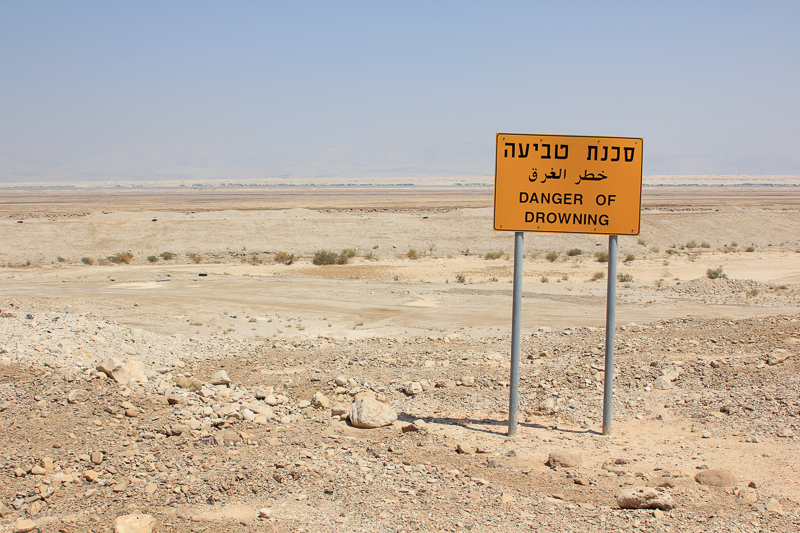
Now the really cool part about the Dead Sea is that you really do float. In general, I tend to sink. Not here. A person cannot sink. I doubt a brick could sink. It’s impossible to get your entire body underwater at one time. It’s as though someone took a bicycle pump and had a go at turning you into a balloon. Stick your leg down, and it floats back up almost instantly. Stick your legs out, and you tip backwards. Put your head back, and it’s like there’s a pillow there. When I finally manage to get myself upright, I floated up out of the water close to my nipples. It really is a remarkable experience once you get over the pain of salt sneaking its way into ever orifice. One local described it like swimming in soup. That’s about right.
I rinsed off, trudged back to the spa, and then was on my way back to Tel Aviv, driving below heavily guarded settler communities atop the barren hills. It’s almost Sunday, and it seems I’m expected me to work on this trip…
 Writing In Secret