Gunfire, Figs, and Missing Road signs

I’d never been to the West Bank until today. And I certainly hadn’t planned my first experience to be at night, lost, and with the massive security barrier rising up beside me. The road was unlit and curved through empty fields littered with half built structures. There were no road signs or any other indication I was even still in Israel proper. I began to worry. The dark made it very easy to believe this was the West bank of CNN, a place of rock throwing youths, suicide bombers, and brutal street battles between Palestinians and the Israeli army. And now here I was, lost and alone in an Avis rental car. I looked down at the Google map I’d printed off earlier. It showed all sorts of roads, none of which seemed to exist. Stupid, stupid Google maps. How bloody hard could it be to find a world famous hotel that was just two blocks off the main highway running through Jerusalem? Well apparently beyond my skills. I looked in my rear-view mirror. Jerusalem was well behind me now. I was getting deeper and deeper into a region even many Israelis refuse to drive. I swore in frustration. Three hours earlier I’d been presenting a Power Point deck and making jokes about choosing the wrong font. Now I was somewhere lost in the West Bank with only a Cliff Bar and Diet Coke. This was how stupid people died.

Five hours earlier in Tel Aviv my plan had seemed very simple. I would rent a car from the local Avis office, drive to Jerusalem Thursday afternoon where I would check into the American Colony hotel, and then spend Friday exploring the old city. Saturday, in daylight, I would head into the West Bank stopping at Qumran to see where the Dead Sea scrolls were found, float in the Dead Sea at Ein Gedi, and finally climb the Roman siege ramp at Masada. Aside from getting locked out of the car while the alarm blared, the plan had started off well and I had quickly left Tel Aviv behind.

The landscape around Tel Aviv is flat and unremarkable, but as you approach Jerusalem it changes dramatically and becomes the sort of place you expect to see Harrison Ford getting chased by angry Nazis.  The air becomes dry and hot. The hills are rugged and steep, some forested with conifers, and others barren save for a few dusty olive trees. Looking up, it’s hard not to imagine the armies of the Romans and Egyptians marching through and swearing about the heat.  The Israeli’s say in Tel Aviv they play, and in Jerusalem they pray. I could feel the change already. It was nearly evening and cars of orthodox Jews had begun to pull over with dusks approach to pray. And then without warning I was in the outskirts of Jerusalem. A few kilometers further and I’d be at the internationally recognized eastern border of Israel. The drive from Tel Aviv is not far at all. I understand now why Israel is so determined to keep the West Bank as a buffer.   They say a mechanized army needs space to maneuver.  Retreat much more than a few kilometers from the hills around Jerusalem and your soldiers are drinking mojitos on the beach.

Tomorrow I would explore the city. Today my only goal was to find the American Colony hotel, and with darkness approaching I wanted to do it quickly.

Jerusalem is a city that time forgot.  It’s also a city that forgot to use street signs.  Perhaps this is a defensive strategy. Given its proximity to a simmering war-zone, it really should put up some sort of indication that unless you know exactly where you are, likely where you are is not where you want to be. By the time I realized what was happening, Highway One had dropped from its full three lanes down to just one. The sun had set, I was the only car passing through a barren construction zone, and the massive concrete security barrier had risen beside me.

The barrier is almost fifty feet high in places. It snakes up and down the hills, holding back the flood of Palestinian apartments that push up against the concrete.  It really is intimidating, especially at night with razor wire glinting in the wall’s security lights. Behind the wall are the dark silhouettes of buildings in the Palestinian ghetto. I could not help but think the barrier dehumanized those on the other side. You don’t build a wall unless there’s something dangerous on the other side, right? I suppose if I’d been living in Israel earlier in the decade, when suicide bombers were slipping into Israel proper on a weekly basis, I’d have a rather different view of the wall.  It did stop the violence within Israel, of that there’s no question.  But it also turned the West Bank into a giant prison. Looking up at the wall, there was no doubt in my mind that is exactly what it was. A prison wall. Only here the prison held towns, and families, even children.  There has got to be a better way.  A local Israeli man said he didn’t think the violent acts committed by the Jewish Stern Gang before independence were radically different than what the Palestinians try to do today.  Many would disagree.  When I asked if he’d ever been to the West Bank, he said no.  Almost no one I asked had.

I pulled the car over, got out, and simply stood there for a time watching the wall. In all the windows, of all the buildings behind it, I never once saw a sign of life. I’m not sure what I expected to happen, but nothing did. The night was quiet. I got back into my car, turned around and headed back in the direction I though Jerusalem to be. I ignored the map, drove on instinct, and eventually found my way.

The American Colony Hotel is one of the most evocative hotels in the world.  It isn’t in the relative calm of West Jerusalem were most tourists stay, but rather east of the UN Demarcation line that kept the Jews and Arabs apart until the last hours of the Six Day war in 1967.  T.E. Lawrence spent his days here in the courtyard after World War I, no doubt planning to study up on how to ride motorcycles, but instead lulled into a stupor by the courtyard fountain.  Today it is the haunt of spies, journalists, and diplomats. Secret negotiations were held here before the signing of Bill Clinton’s Oslo peace accords which put an end to the first intifada in the early 90s.  There is no better accommodation in all of city to experience what Jerusalem is today.

For an unknown reason I was upgraded to the penthouse.  I did not complain. The rack rate for the room was nearly a thousand dollars a night and it was easily worth every penny, especially given that I didn’t pay most of them. I dropped my bags in the spacious room, stepped out onto the terrace, and smiled. A plate a fresh figs and dates awaited That evening I sat out on the terrace until late, listening to the sound of the waterfall in the garden below. Muezzin sang in the distance to call the faithful to prayer, the lights of the ancient city crawling up into the hills, and the sounds of gunshots echoed in the distance.  It’s an incredible place.  If I ever become so famous I need to disappear for a time, this is where I will go.  Perhaps in the morning the image I’ve built will crumble down.  I’ll see grime and chipped paint, the disparity between the Jewish and Muslim populations in the city, and realize that my penthouse terrace is part of a world that doesn’t really exist.  But for right now, I must go.  A meteor shower has begun, and it’s difficult to type while laying on the patio watching meteors streak above one of the world’s oldest cities.

War and other things

Talk of war is everywhere here in Israel.  Front page articles proclaim the military is battling against Bibi and his desire to blow stuff up, Iranian stuff mostly.  Not to be left out, the lifestyles section of Haaretz got into the act yesterday publishing the important piece, Eat, pray, eat some more; How to stomach the impending war.  “With all the talk of warfare, we mustn’t ignore one of the most vital issues we may soon face: What to eat in bomb shelters?”  Important stuff, that. Perhaps this ever present threat of war explains why the beaches here are still full and no one seems much worried about getting skin cancer.   Israelis still honk impatiently in anticipation of the green, cafes are full, and there’s canned tuna on store shelves. Daily life continues without interruption.

Having spent yesterday in the Negev, today I was going north to the Golan and Galilee. The Golan and Galilee aren’t at all the same as the Negev and might as well be in an entirely different country.  These are the breadbasket of Israel and are rich with green fields, forested hills, and a gas station attendant who sat me down with a thick black cup of coffee while we waited for my car’s tank to fill.  I really don’t like coffee, but he was an incredibly friendly man and I couldn’t refuse his offer. Sipping the coffee slowly, and contorting my tongue to avoid the flavor, I couldn’t believe how much gas the car’s tank held.  I should have rented a hybrid.

Before setting out I thought back to just how quiet the Negev desert had been. I’ve never heard such utter silence before.  This wasn’t just the silence that says, listen, I can hear crickets.  It’s as the sort of silence that make you wonder what killed all the crickets. It’s the sort of silence you’d hear after asking if Tom Cruise is gay during Scientology cocktail party.  You see where I’m going with this. The desert is quiet. Early in the morning, when the air was still, without birds, insects, or kids asking for breakfast, I had stood there and listened to the sun rise over the Negev’s Martian landscape.  Pretty amazing actually. I hoped today went as well.

After a cold breakfast, Sabbath you see, I started Saturday morning at Hamat Gader, the ancient Roman spa complex built by members of the Roman 10th Legion and considered one of the finest Baths in the ancient world.  Perhaps there are two Hamat Gaders, and I found the other one.  Modern Hamat Gader abuts Jordon and is only accessible by driving along the heavily fortified border, strung with barbed wire, multilayered fences, and minefields.  Across a steep ravine I could see the Jordanian watch towers looking across at what until the 1960s was part of Syria.  I paid the ridiculously high entrance fee comforted by the knowledge that I was about to see the second biggest Roman bath complex in the world after all. I ignored the signs for the Middle East’s largest alligator farm and got my camera ready.  I should have come for the alligators.  What little of the bath complex has been excavated is furlong and off-limits behind a rusted chain-link fence.  No one comes to see the baths, it seems.  They come to see alligators. Nearby, heavily armed paratroopers patrolled within the modern spa complex, on the watch for any Islamic terrorists who had jumped the nearby border fence and come for a mud and sulfur treatment. I didn’t stay long.

Israel 102 - Copy

After the disappointment of Hamat Gadar I headed north along the Golan Height’s DMZ, keeping beside the border as much as possible as I searched for the Valley of Tears.  Caught by surprise during Yom Kippur, it was there that some two hundred Israeli tanks held off five times that number of Syrian tanks which were sweeping westward across the Golan Heights.  Israel tank crews, celebrating Yom Kippur at home, had rushed to their marshaling areas as the front lines began to collapse.  There was no time for a coordinated response; as each tank had enough men, regardless if the crews even knew one another, they were sent east into the fight.  The fight was brutal. Today a few Syrian tanks remain abandoned in the valley, rusting quietly, gaping holes where Israeli shells found their mark.  It’s a rather somber place and certainly offers a more compelling narrative than Canada’s Laura Secord and her cow.

Standing alone on a ridge above the valley, I pressed play on a small speaker box and listened to the recordings of the Israeli tanks crews shouting to one another over their combat radios.  At one point only a handful of Israeli tanks were still operational. The rest were burning along the ridge.  A local named Moshe told me the story of his uncle who’d fought in that battle.  Standing exposed in his tank hatch, he’d yelled down to his driver to fire, but the driver yelled back that the couldn’t see anything to fire at, his portal was blocked.  Fire now, his uncle had yelled again.  The portal wasn’t blocked.  A Syrian tank was so close it filled the entire view.  Regardless of how you feel about Israel, the Palestinians, or the wider Arab word, it’s a somber place worthy of respect. I stood there quietly for some time before moving on.

Israel 141 - Copy

The remains of a Syrian tank. Doubtful it’s crew survived the strike.

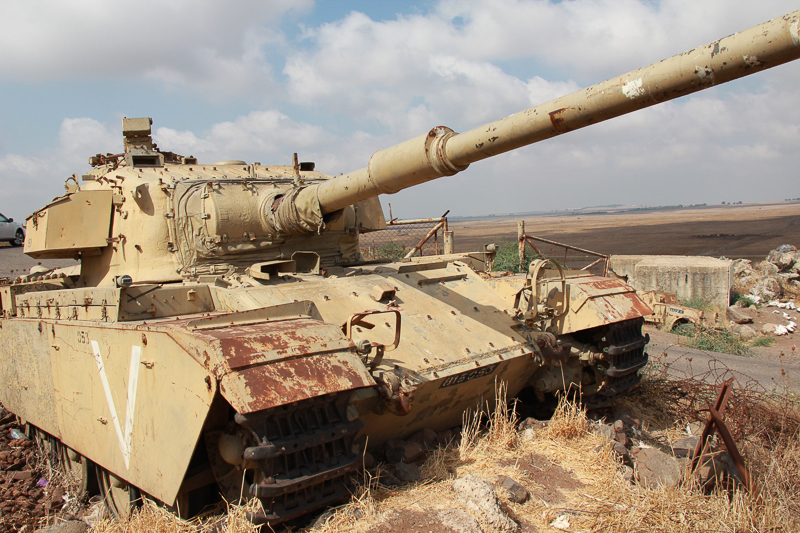
Israel 130 - Copy

An Israel tank left as a reminder of war past in the Golan Heights.

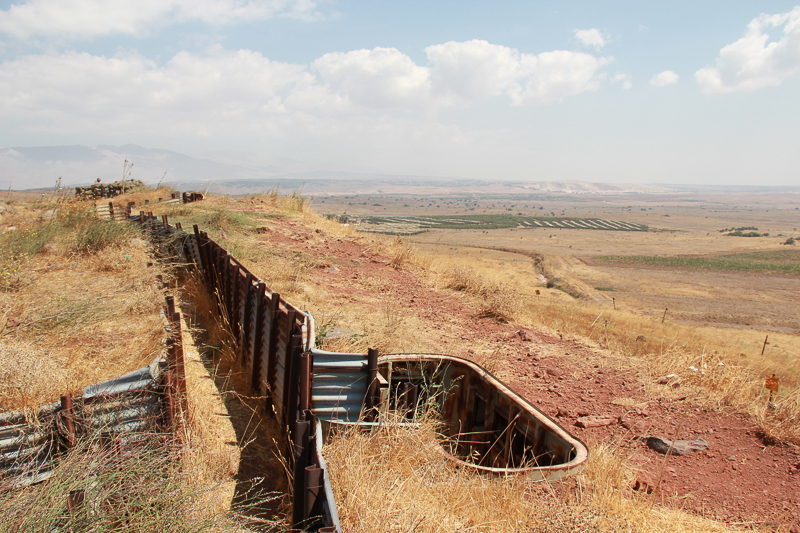
Israel 142 - Copy

Israeli trenches looking out over what was once part of Syria.

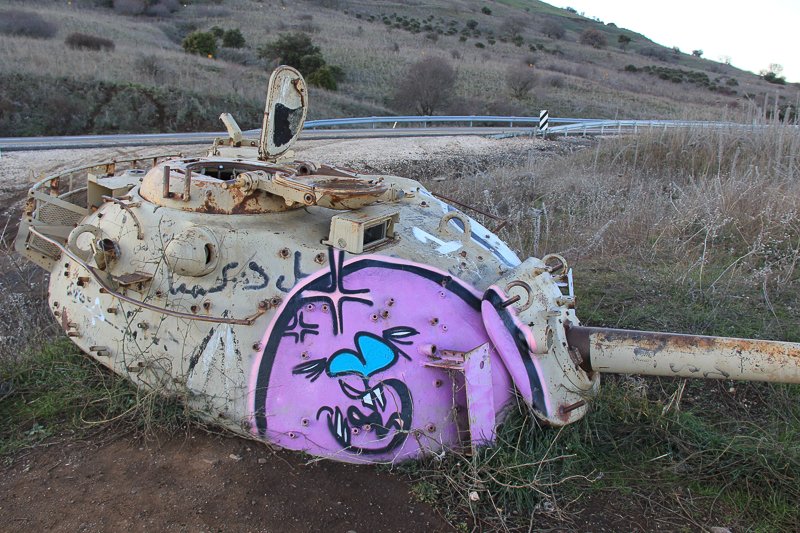
israel 244

Graffiti and war.

Further north I stopped at Nimrod’s fortress which once commanded the ancient road to Damascus.  It’s massive, hot, and looks like someone picked it up and shook it to see what would happen.   Earthquakes are not subtle things.

Israel 150 - Copy

Before heading south back to Tel Aviv I stopped for a few hours at Banias, an ancient temple to Pan, tucked away by the side of a cliff, and overlooking a cold mountain spring.  It is everything the Negev wasn’t.  Noisy, wet, and lush.  A path follows the quickly running spring for some distance, finally ending at a rather beautiful waterfall that drops into a dark and moody pool. The air is cool and full of scent.  Along the path I stopped next to the remains of a Roman mill and ate wild figs picked from a nearby tree.  There are worse ways to spend a day.

Israel 174 - Copy

Camel Dung and water Bottles

In Tel Aviv the Israel’s have managed something quite remarkable for such a young city.  They’ve made it look old.  It strikes me every time I’m here.  The city itself is alive and full of energy; I can hear the beach parties going on as I type this and they’ll continue into the early morning.  Walking home from dinner at ten-thirty a few nights ago young kids hovered around ice-cream trucks, multi-generational families cooked on portable grills, and a young Hasidic man danced with traditional foot stomps and claps to techno house music coming out of portable CD-player.  A little surreal actually.  But with all that life, there’s an ever present level of decay that reminds me of southern Italy.  No one cares about the exterior, unless it’s wearing a bikini.  Must be the heat.

I have two free days this trip and want to finish exploring the bits of Israel I haven’t gotten to before.  Today that meant heading south into the Negev, a desert region that covers more than half the country’s territory, and the name of which apparently means dry.  In Antiquity, the Negev was known as the final leg of the journey of incense, brought overland by camel caravans from Arabia and then shipped out to the Mediterranean world from the port at Gaza.  What fascinates me is that the route is still visible in the form of ruined way stations and Caravanserai built by the Nabataeans, the folks who gave us Petra.  If you’re so inclined you can even walk the old route, starting at the Jordanian border, nearly dying in the blistering heat as you cross the desert, and finally getting shot at as you finish up by climbing the Gaza security fence.  I rented a car.

I left the hotel at five A.M. with hopes of avoiding the worst of the heat.  I stopped first at Shivta, one of the four major Nabataean towns that housed, cared for, and taxed the hell out of the incense caravans.  When I arrived at seven it was utterly empty, possibly due to its spot wedged between the Egyptian border and an Israel Defense Force live fire range.  It may also have been because it didn’t open until eight.  Either way the site’s staff wasn’t there yet so I missed the sign that said it was closed and wandered the streets that were lit by the golden morning light.  They say the Nabataean’s were masters of collecting and storing water.  They had to be.  It’s hard to imagine building a town in a more desolate location, at least until you visit their other sites deeper in the Negev.

Over the course of the day I stopped at Avdat, En Saharonim, and the curiously named Mamshit.  The pattern with each site was the same; functional, brutally inhospitable, and devoid of any life but that which I brought with me.  It’s a shame really; as with just a bit of imagination you can easily smell the stench of a courtyard full of snorting camels, flee infested drivers, and local prostitutes helping spread disease up and down the route for an obol or two.  But the Negev isn’t only about broken down ruins and Israeli nuclear weapons program. It’s also about the environment.

It started with En Avdat, a stunning oasis set amidst the most barren terrain imaginable.  There water flows from three separate springs and has carved out a deep canyon with horizontal lines of jet black flint breaking up the canyon’s otherwise white walls.  Within the canyon, the year-round flow supports waterfowl, turtles, and a small population of Nubian Ibex.  You’re meant to see them springing across the cliff face with utter disregard for gravity.  Instead I found them sitting under a 350 year old terebinth tree, the sort of plant from which you get turpentine.  I think the heat had gotten to them too.

Following En Avdat was Makhtesh Ramon, a massive 40 kilometer long, 10 kilometer wide hole in the ground, nearly half a kilometer deep.  The thing is immense, and although they call it a crater, it was actually formed by a rather complex series of processes that really amount to an ocean that got lifted up and dumped out.  There’s 200 million years of geology there and everywhere you look there’s something unique, from black mountains, to red rocks, and yellow hills.  And if you listened closely enough on that day you could even hear a Canadian cursing that the caravanserai which Frommer’s said was just 2000 meters off the main road, was really more like ten kilometers down a rocky path that threatened to rip apart the rental car’s suspension.  Next time I rent a 4×4. I do not like Frommer’s. Not one bit.

Amidst all of this wonder are Israel’s remaining Bedouin, the vast majority having fled, or been forcibly removed, during the war in ’48.  Now they cluster around Be’er Sheva where their mad-max like villages cling to the otherwise barren hillsides.  They are neglected, jobless, and unless I’m underestimating the value of second-hand corrugated steel building materials, dirt poor.

Tomorrow I go north.

Sunrise over Armageddon

This is a bit long, but then so was the flight.

You know it will be a good day when your first stop is sunrise over Armageddon.  I woke Friday while Tel Aviv was still asleep, grabbed a quick bite to eat, and then headed north-east towards Israel’s heartland.  I planned to skirt the West Bank until I reach the River Jordon, follow it north into the Galilee, turn eastward at Nimrod’s Fortress along the border with Lebanon—you can’t actually go further without getting shot and hence becoming a bit of a Nimrod yourself—and finally circle back around south across the Golan Heights along the DMZ with Syria.  This would take me past some of the oldest cities in the world, through the Greco-Roman world of Herod, biblical sites along the coast of the Sea of Galilee, beneath Crusader fortresses on the high bluffs, and finally see the result of the region’s most recent wars.  All this in one day with only the map provided by Avis.  What could go wrong?

For a place that’s meant to host the end of the world, Armageddon is a rather sleepy ruin that required the custodian to use his broom handle to reach up and turn on the lights.  By the time I was done walking about he’d managed to light a cigarette.  If Armageddon is coming, it’s going to have to get used to waiting.  The one notable feature, aside from hosting the end of the world, is the ancient city’s water-works, a massive pit dug straight down into the bedrock.  It descends over 100 feet before leveling out into a long tunnel that leads to a spring outside the city walls.  It’s a precarious trip down even now; I can’t imagine how they did it before the invention of public safety.

After a brief stop at a bus stop to buy a simit like round from an Arab kid who spent most of his time texting, I arrived at Scythopolis.  Utterly destroyed in an earthquake during the 8th century, Scythopolis is a massive Greco-Roman excavation with everything you’d expect from a proper Roman city including 2000 year old public toilets.  This was the first place that had foreigners in any number, and must be one of the big sites for tours coming out of Jerusalem.  Amidst the ruins there’s an ancient Tel that’s been inhabited since before written history.  Although it’s a bit of a hike, from the top the view is pretty spectacular, but what caught my eye were the remains of an ancient bridge on the other side of the Tel, the side without the marble Agora, well-kept theater, or busloads of tourists from New York.  I climbed down, headed down a deserted path, trudge through a bit of underbrush and finally got down to the water’s edge.  It looked like something from an 18th century pastoral painting.  All that was missing were the scantily clad Rubenesque women who had the unfortunate habit of slipping out of their tops every time an Italian painter happened by.   There was a shepherd and his flock atop a nearby hill, thick Egyptian grasses swaying in the breeze at water’s edge, and above it all the ancient bridge reached over, its arch half collapsed, letting light filter down to the gurgling water.  Pretty damn impressive and the photos I took won’t even begin to do it justice.

I won’t bother mentioning my time in the city of Tsfat.  Frommer’s mentions it.   Frommer’s is the reason I went to it.  Frommer’s is stupid.  The hour long side trip I took to get there is an hour I want back.  The Crusader Castle of Belvoir, however, was easily worth the damage I did to the rental car engine while climbing the twisting path to the promontory on which it sits.  Commanding the Jordon valley below, Belvoir was the last castle still held by the Crusader’s when Saladin’s forces finally took back the region.  And unlike the others which fell to his siege, Belvoir never did. The Hospitallers inside finally surrendering when they realized the only land the Latin Kingdom of Israel still had under its control was roughly the distance they could piss from their castle walls. For fear of it being re-occupied one day, Saladin had the castle mostly torn down, but it remains impressive.

Winding my way further north I crossed the Jordon river a number of times, but if there hadn’t been a sign, I wouldn’t have noticed.  We would call it an irrigation ditch.

The Vatican has a small church on the western shore of the Sea of Galilee, reputedly built atop the rock where Christ performed his miracle of feeding thousands with a single loaf of bread.  All sharp angles, it looked to be a terribly uncomfortable place to stand about making bread, especially in sandals, but then I’m not the Messiah, so what do I know?  There’s another rock nearby where he appeared after his death.  In a region that’s full of exposed rocks, it’s impressive someone had the wherewithal to record both spots and never lost track of which was which, not even once, but did manage to lose the nearby Roman city of Scythopolis.

I had come to the area for two reasons.   My daugher’s teacher had asked if I could take some religious pictures for the class and  I was also curious to get a flavor for a region that’s been such a major part of western culture.  I’m not sure what I was expecting, something a little more serene I suppose, perhaps with an old wooden boat bobbing along the shoreline, fishermen casting out their nets, maybe even a donkey or two.  Something.  Good luck with that. Instead, seeing the biblical sites of the Galilee doesn’t require faith, it requires you to close your eyes and pretend you’re somewhere else.  Instead of anything even vaguely evocative, what I got was Tiberius, a massive sprawl of resorts and holiday go-ers who flock to the region in the summer for its beaches.  It’s brash, and loud, and the sort of city where they serve fries with everything.  The whole place smells like Piña colada scented sunscreen.  After taking a few pictures of the church, and picking up a pamphlet for my daughter’s teacher, I stopped at the Church’s bathroom where I paid my Shekel to the attendant outside, one of the monks, went in, and then heard his voice, much closer this time, slightly off to my right now, and asking where I was from, if I was alone, and generally making small talk while I stood in front of the urinal doing my business.  The Roman Catholic Church should seriously look at its hiring policies.

Why all Israelis aren’t bi-polar I’ll never know.  They live in a strange netherworld between war and peace.  The day before, while in a meeting with the company I had come to see, I heard a major event was happening near the borders with Lebanon and Syria atop Mt. Hermon.  The Syrians and Israelis have fought over the mountain a number of times, the last during the Yom Kippur War when Syrian commandos overwhelmed the small Israeli listening post.  It was that same listening post that had noticed the massive Syrian army buildup the day before, but been ignored by their command hierarchy.  Arab armies were not capable of attacking Israel, so had gone the thinking on October 5th.  On October 6th Israel was invaded on two fronts.   I arrived late in the afternoon, the colour of the land slipping into gold as the sun sunk towards the horizon.  Nimrod’s fortress was to my left, perched on an impenetrable spar of rock.  A steady stream of cars was coming down from the mountains to my right.  As I climbed up through the winding passes, the thermometer in the car was slowly sinking towards zero.  And then, after rounding a bend, there is was, the reason tens of thousands were streaming past.  Snow.  Israelis were grabbing great handfuls, throwing it onto their car hoods and heading back down into the Galilee and beyond.  I suppose they were hoping the stuff would survive the trip.  I don’t really know.  Local Druze stood on the side of the road selling fruit, bread, and hand knit touques.  It was getting late so I snapped off a few photos and then headed the other direction towards the Golan Heights.  And here’s the thing.  Within two minutes of heading towards the Golan Heights, a rusting old fence was running along both sides of the road with yellow warning signs plastered ever fifty meters warning of landmines.  The place was absolutely littered with them and explained the general advice to never stray off the road.  To my left, towards Lebanon, a razor wire fence snaked through the hills.  Hezbollah were just a few hundred meters away and yet only a short distance behind me Israelis were happily skiing down slopes, careful to stay on the well-marked paths so as not to explode.  Odd.

Israel will never give up the Golan Heights, that’s clear to me now having driven through it.  It’s simply too close to their population centers to cede to a foreign power, especially one they have a tendency of getting into wars with.  Amidst the mine fields, I drove past abandoned villages where buildings had blown out walls and farm equipment was slowly rusting back into the earth.  The Golan Heights is an area expecting another war.  There are massive stone tank traps intersecting roads leading towards Syria which forces you to slow to a crawl as you navigate through, no doubt providing future Israeli tanks ample opportunity to destroy anything coming the other way.  There are hilltop forts brisling with all manner of listening equipment focused on the Syrian plains below.  There are small memorials to particular tank brigades that were called up from the population in their desperate attempt to hold back the Syrians.  And there are Shelter signs everywhere, pointing to culverts or bunkers beneath the roads.  In-between vineyards and mine fields, small Israeli settlements have sprung up. Unlike the well-built suburbs of Jerusalem that push into the West Bank, these have a more militaristic feel.  There’s little else here besides these news settlements and remains of the last war.  I stumbled across the turret of a Challenger tank from ’76, its gun still pointing eastward, and another area where a Syrian bunker had overlooked the Israeli towns in the valley below.  Barb wire and trenches have been left where they were when the last war ended, no doubt as a reminder why Israel won’t be leaving any time soon.  Standing amidst the ruined Syrian fortification I could see the entire Israeli plain below.  They say gunners here used to take pot-shots as Israelis working their fields below.  I wanted to spend more time, but the sun had set, and without GPS or a descent map I figured it was time to go.  I turned westward and began the descent back into the Galilee.

You don’t take a sign that says Danger, Tank Crossing seriously until you happen across an Israeli tank brigade crossing.  Just past, along the side of the highway, there were at least thirty tanks plus various smaller support vehicles pulling into a field for the night.  It’s a powerful reminder of just how serious the whole thing really is up there.  I pulled over and approached one of the guards.  His assault rifle was slung low down across his chest the way they carry their weapons here.  I asked if I could take a few photos.  One, maybe two, he said sternly.   I took one.  You just don’t argue with a guy who’s just climbed out of tank.

The last time I was here, when I asked for local food, the Israelis wondered if I meant Eastern European, and then joked that I probably meant Middle Eastern.  Nothing has changed.  Tel Aviv is a wonderful place if you’re looking for Sushi, or Thai, or a great steak house, but anything Arabic, forget it.  Earlier in the week I had spent half an hour researching where I could go out to eat, finally settling on a place run by Jews from Eastern Turkey who’d brought their skills and culinary heritage with them to Israel.  No one mentioned they’d run the local school cafeteria back in Turkey.  When I saw long tables looking ready to take in bus tour groups I should have run away.  But it was late, I hadn’t slept in two days, and I just wanted some food.  That was a mistake.  This cycles repeated itself nightly until finally on Thursday I ended up at a place in Jaffa, the old Muslim quarter of Tel Aviv.  The restaurant hadn’t been listed anywhere, but what a feast.  The mixed salad plate included 14 separate dishes, and when I inquired if I would be getting pita, the waiter looked at me as though I were an idiot and said, of course, we’re making it now.  It’s rare that I’ll gorge myself in a restaurant, but I had to.  It was simply one of the best meals of my life.  I sat their eating for an hour, a pitcher of freshly pressed pomegranate on the table.  There were dishes with tangy apples, an amazing cauliflower, pickled cumquat, olives, eggplant, and bits I couldn’t recognize but tasted wonderful.  It was the perfect bento box if the Japanese were Muslim and had a habit of eating goats.  My main course was a lamb kebab in a rich tomato broth, baked within a pillow of sesame encrusted flat bread.  Who needs the 40 virgins when you have that sort of meal?

My only real disappointment was a lack of baklava.  Last time I was in Israel, I found the most amazing variety in East Jerusalem.  The one guy I found selling something similar was in the covered market in the old part of Tel Aviv.  I asked for one piece, he put three into a container.  I told him no, I only want one.  He took one out, and tried to give me two.  Whatever, I gave in, remember that last time I’d gone back for seconds, and asked how much?  He told me 20 Shekels, which is roughly five dollars, or about 3 times the price in Canada.  I frowned and said too expensive, so he quickly dropped down to 10 Shekels, at which point he was just plain annoying me.  I don’t mind a bit of haggling, but if you start off by trying to rip me off, I’m going somewhere else.  So I did.  Of course I never did get my Baklava.

One last thing.  Last Wednesday morning I headed out to Akre, an ancient city that once served as the Latin Kingdom of Israel’s capital until it fell to the Arabs sometime in the 13 century.  It’s a wonderful old city, fully of crooked alleyways, dark tunnels that snake beneath the fortifications and a beautiful old Ottoman bath where I was forced to watch a 15 minute long video reenactment of what it’s like for a small thin man to massage a large fat man.  I could have gone back to the Church in the Galilee if I’d wanted that.

Setting aside the politics, Israel remains an amazing place to explore.

Hummus, Guns, and Sabbath Games

Here are some last observations before I hop on a plane tomorrow.

Israeli Food

There is no such thing as traditional Israeli food.  Sitting down for lunch with a small group of friends highlighted the challenge here.  Two were from Ukraine, another two from Moldavia, one was an Uzbek, and one a Pole.  Only the Pole was born in Israel, the others had immigrated as children. These were not people who grew up eating feta and figs. For them it was cabbage and vodka.  So when I brought up the topic of local food, they all sort of shrug and suggest that I was looking for Arab food.  I didn’t bother mentioning that I thought Arab food was Israeli food.  In Tel Aviv, Arab food was not as easy to find as I had thought.  Neither the grocery store across from my hotel, nor the hotel itself, had pita for the hummus I’d bought earlier in the day.  French baguettes, however, were available aplenty. I ended up eating the hummus with a loaf of white sandwich bread.  I might as well have been in Iowa.

Which brings me to the institution known as Abu-Hassan. If you didn’t know any better you’d think it was a rundown hole in the wall that served little more than ground up chickpeas mixed with tahini, olive oil, garlic, and lemon juice. Well okay, you’d be right, but you’d also be missing the point. Abu-Hassan does one simple thing very well. The make the world’s best hummus. Across all of Israel, since the mid-60s, when someone wants to go out for the perfect hummus, they get in their car and drive down to Jaffa, the old Arab Quarter of Tel Aviv, and wait for a table at Abu-Hassan. Hummus here is not a side dish. It’s the only dish. You sit around your beat up old table, on cheap metal chairs, and scoop hummus by the mouthful. Note: this is not the sort of place you ask for a receipt.

Checkpoints

I’ve seen three distinct types of checkpoints in Israel.  The first control access to buildings and public transit.  The simplest has the pencil thin Falasha Jew from Ethiopia who likely isn’t armed.  He’s got a wand, checks your bag, and waves you through.  At train stations they add in the typical x-ray bag scan and have pistols.  If something goes down, I’m assuming they yell bloody murder and the police will come charging while the civilians scatter.  The second type is the car checkpoint.  There’s a fair bit more conversation about one’s purpose, and then a mandatory trunk check looking for bombs.  My Canon 200mm great white lens in the trunk was the topic of conversation and slowed me down considerably.  The guards at these checkpoints are armed with weapons bigger than pistols.  If they find something that upsets them, you’re stuck behind a barrier and are likely going to get shot.  On the highways the military handles the checkpoints and they carry assault weapons.  A Caucasian Canadian who doesn’t speak Hebrew gets an easy wave through.  Arab Israelis don’t have it so easy.  There is very clear racial profiling happening here, but then that’s not wildly surprising given the frequency, in the late 90s, of Palestinians blowing themselves up. The final sort of checkpoint straddles the security barrier between Israel and the Palestinian territories.  These are the ones you really don’t screw around with.  Purpose built and nasty looking, no one here is playing games.  Battle ship grey, hung with barbed wire, and manned by heavily armed soldiers, they’re ready to stop an insurrection if need be.

The Sabbath

Israelis don’t say Sabbath, they say Shabbat, and for those who follow it, what a wildly complex beast it is.  I first noticed the effect returning to my hotel in Tel Aviv one Saturday night.  Although the mechanized gate arm was still functioning, the revolving door was not.  For reason I do not understand the former did not violate Sabbath, but the latter did.  Three of four elevators were operating normally, and the forth had been configured to stop at every floor, over and over, so that a devout Jew need not press the buttons to actually make the blasphemous contraption do his bidding.  Pressing an elevator button, after all, is a grave affront to God.  Listening to a bastardized version of Sweet Child ‘o Mine by Guns ‘n Roses as you ride up, is not.  Apparently it’s the little details that really get under God’s skin.  The mechanical keycard to enter my room was okay, but turning on the lights was not.  Opening the closet door which automatically turned on a light was also very, very bad.  Only cold dinners were available, cooking after all would violate the rules, but opening the fridge door to get out the cold tuna salad did not.  When the kitchen staff opened the fridge door to get the tuna, I wonder, did the light go on?

There’s a joke here, and it goes like this:

God:  Moses, it is cruel to cook the meat of a cow in the milk of his mother.

Moses:  So you’re saying we should not eat meat and milk together.

God:  No.  Just don’t eat the meat of a cow with the milk of that cow’s mother.

Moses:  So you’re saying we should have two separate sets of plates, one for dairy, one for meat.

God:  No.  It is cruel, Moses, to cook the meat in the milk of the same cow’s mother.

Moses:  So you want us to wait 6 hours after eating meat, before we have dairy.

God:  Moses…fine, do whatever you want.

Jews and Palestinians.

The relationship between the Jews of Israel and the Palestinians of the occupied territories is complex. The relationship between the two ethnic groups within Israel proper is even more so. For the most part Jewish Israelis never call their Arab neighbors Palestinians, they call them Arabs.  This, no doubt, is a deliberate attempt to remind the world that in Israel’s eyes there is no such thing as a Palestinian. Many of the Jewish Israelis, especially those from Tel Aviv which has almost no Palestinian population, are afraid of the Arab population, and are reluctant even to drive into Israel’s Arab areas, even if it means missing out on a good meal; Cabbage and Vodka can only go so far. Unlike their parents, many of the younger Israelis see the current problem along economic lines. They believe the Palestinians need a viable territory and jobs…a two state solution.  They view the West Bank as Palestinian territory which should become a Palestinian nation.  They don’t hold the West Bank and its religious sites in reverent awe, but then of course many of them also eat bacon.  At the same time, they fear the Palestinians do not see the world in the same way.  Jobs, they fear, are secondary to the politics of Israel’s existence.  Still, with the younger generation there’s always hope.  But then mortars, fired from Gaza, just landed in the south, a Palestinian has been shot trying to take hostages at the Turkish Embassy, and I am working in a conference room in the middle of a building which has a steel door and a ladder which runs both up and down to other similar conference rooms.  Why I asked does it have a ladder?  Because it’s also a bomb-shelter.  Ah.  Complexity.

Heatstroke and Soup

First thing Saturday morning I was back on highway One, leaving behind the American Colony Hotel and all its luxury.  Sabbath had begun so traffic was lighter, similar to a typical Canadian weekend.  Most Israeli’s simply aren’t that devout.  There are areas of Jerusalem where the ultra-orthodox will stone your car if you drive on the Sabbath, but the orthodox remain a minority, and typically keep to their own areas.  Despite all of the their indignation at Sabbath driving, it’s not easy getting out to throw stones at cars on the highway when you have to walk the whole way.  Sometimes the universe appreciated a bit of irony.

The first military checkpoint is just east of Jerusalem, and for what matters, this is where the West Bank really begins.  For the first time a new type of car appears on the road, one with green plates with a distinctive “P” on the left side.  It’s a not so subtle way of telling you that this car belongs to a Palestinian from one of their West Bank enclaves.  Without that plate, however, you might never know.  For the most part it seems Palestinians who can work through the red-tape to get access to the Israeli roads within the West Bank, also have access to funds.  The cars are new and well kept.

Israel 359

Leaving Jerusalem drops you into another world.  It is the line between the semi-arid, but still productive center of the country, and the barren wasteland of the Judean desert.  Hot, bleak, oven like. As many adjectives as you can think to describe heat, this place can use. The scenery is spectacular, particularly if you hate green.  Nearer the Dead Sea there are signs warning of road closures due to floods.  Locals here assure me that flash flood are a real danger, and there are even photographers who go out into the desert to chase them down, but it’s hard to believe when all you see is an endless expanse of rock and heat.

Israel 357

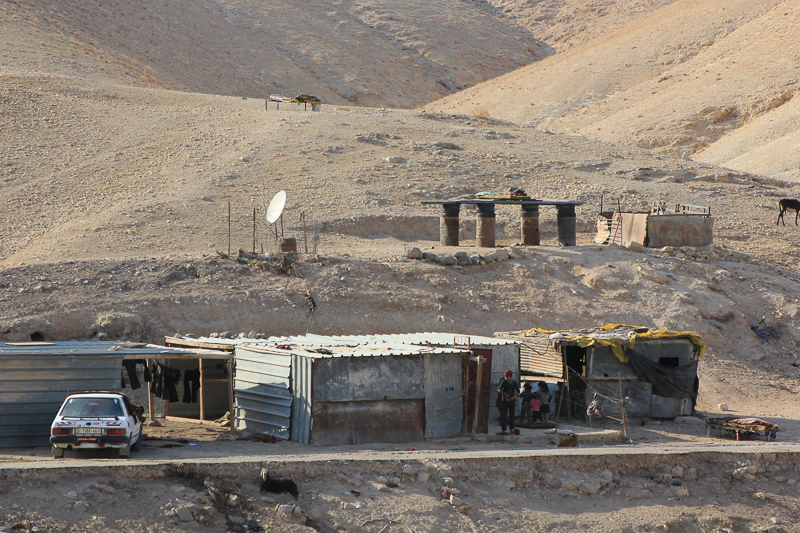
Not far from Jerusalem you see the first Bedouin.  But these aren’t the Bedouin of movie fame.  You aren’t about to see Omar Sharif offering you figs from the comfort of a colorful tent.  These Bedouin look as though they’ve survived a nuclear strike, eking out the most meager existence, their homes clinging to the sides of hills.  These are makeshift structures of corrugated steel and other bits they’ve scavenged.  Nearby, their herd of goat manage to subsist on the barren scrublands.  And then before you know it the Bedouin are gone too, the climate too harsh even for them, and there is nothing left but rock and the occasional military radio mast atop the hills.

Israel 229

My goal for the day was Masada, built by Harod around the time of Christ, and later the scene of the mass suicide of the last Jewish Zealots fighting off the Roman Legions.  For years the Israeli army did their swearing-in ceremony here, until someone realized that perhaps the glorification of mass religious suicide wasn’t the best model for an army with a goal of actually winning a war.  Driving towards Masada, on the west you have a line of desolate red mountains, and to the east the Dead Sea.  It is the only body of water I’ve ever seen that has no plants on its shores.  Nothing.  The landscape is utterly, and totally dead.

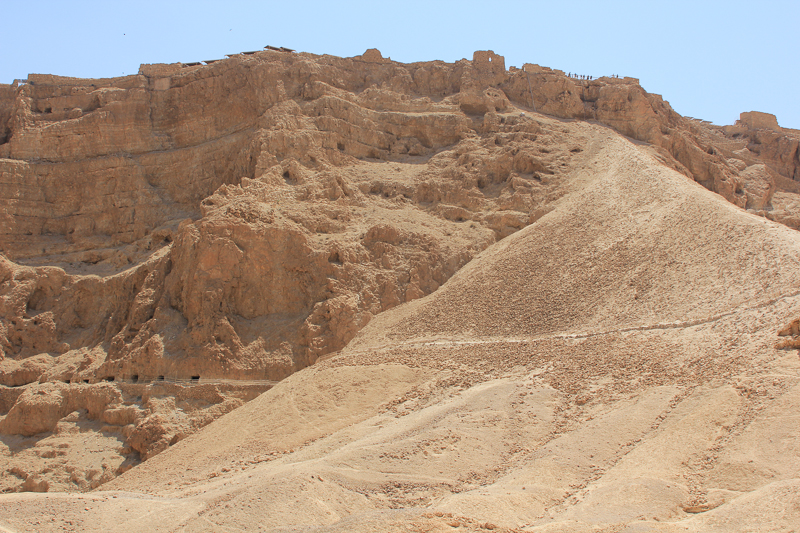
Having had huge expectations I was surprised when I finally reached it.  I had expected a single grand monolith like Ayers rock in Australia.  It’s not.  It’s just one of many burnt red mountains that are part of the long line I’d been driving next to for an hour.  It’s tall enough that at first I didn’t even realize it was Masada.  Unless you look closely you don’t see the tiny trail that winds up the east face or the ruins atop the mountain.  Either the climate really has changed dramatically, or Harod was a madman to build a palace out here.  Its total isolation must have been a reason it fell out of use so quickly once he died.  And my god it was hot.

I had planned to hike the Snake path, the original trail used by Masada’s inhabitants.  On a good day in the winter it can take a couple of hours to climb.  Today, one of the hottest days in the year, it was going to be a nightmare.  Groups stood about in the air conditioned visitors center, slathering on sunblock, getting their water ready, buying specialty hats, all in preparation for the arduous trek up ten stairs to the gondola.  The gondola?  Cowards.  Ready for anything, I marched passed them feeling rather superior, got out to the trail head and stopped.  Close due to extreme heat.  Damn it.  In hindsight, this was a very good thing.  A Danish cyclist died that day from the heat.  No doubt I would have as well.

Israel 326

The gondola ride up is actually rather nice, and a good way to go if you’re not a fan of heat stroke.  Still, there are two sides to Masada.  I was on the eastern side which has the Snake path which can be closed because you can take the gondola instead.  On the western side there’s the Roman siege ramp, but no gondola, so they can’t very well close that one, can they?  Anyone coming from the west has to climb the mountain.  So once at the top I spent a bit of time looking up at the sun and sweating, then walked around to the western side and headed down the path to the mountain’s base.  I had come to Masada to climb it, and damn it I was going to climb something even if that meant going down the wrong side first.

Israel 303

Other than the incredible location, Masada is famous for the 700 Zealots who committed suicide rather than be taken captive or killed by the Romans.  Because the Romans couldn’t possible attack by way of the perilous Snake path, to get to the top they simply built the mother of all ramps and wheeled up their battering rams.  This is why Rome conquered the world.  No one could compete with that.  Today, the siege ramp, a containment wall, and numerous siege camps are all still laid out around the mountain where the Roman left them over 1,900 years ago.  It was a remarkable place to explore, and I did it entirely alone.  The entire time I was there I could count the number of people who climbed that siege ramp on one hand with all the fingers hacked off.  There was nothing alive except ravens, and I’m lucky they weren’t vultures. They would have seen me wandering down along the siege wall, nearly a kilometer from any source of shade, and pecked out my eyes.  At some point my brain kicked in, I turned around, and started the trek back up.  It was head down, one foot and then the other.  There was a good reason the Snake path was closed. Once aback atop, although climbing up the Snake path was forbidden, I realized that climbing down was not, so that’s how I returned to the absolute bliss of the visitors center, and it’s popsicle sales woman to whom I quickly became a regular. The moment my body heat that cold, air-conditioned air, my sweat stopped evaporating and I was drenched.

When Masada fell to the Romans, it was abandoned almost immediately.  Much of what was there was left in place, including human remains.  While leaving the onsite museum the attendant asked me what I found most interesting.  For him it had been eleven clay port shards, each with a man’s name on it…without question in his mind the famous lots the Zealots had drawn to see who would kill the 700 others, and then commit suicide himself.  Lovely group, Zealots.  Historically interesting, sure, but the find seemed just a little too prosaic to be believed.  What really caught my attention was a braid of woman’s hair, as though just recently cut.  Very moving.  One of the wives of the Zealots, says the museum.  More likely a Roman woman captured and killed when the Zealots first seized the place, say modern archeologist.  And the Zealot remains who were given full military burial by the Israeli army?  Likely Roman soldiers from the original garrison.  It’s good that they all agree.

That was the further point south I went.  From there I headed back northwards.

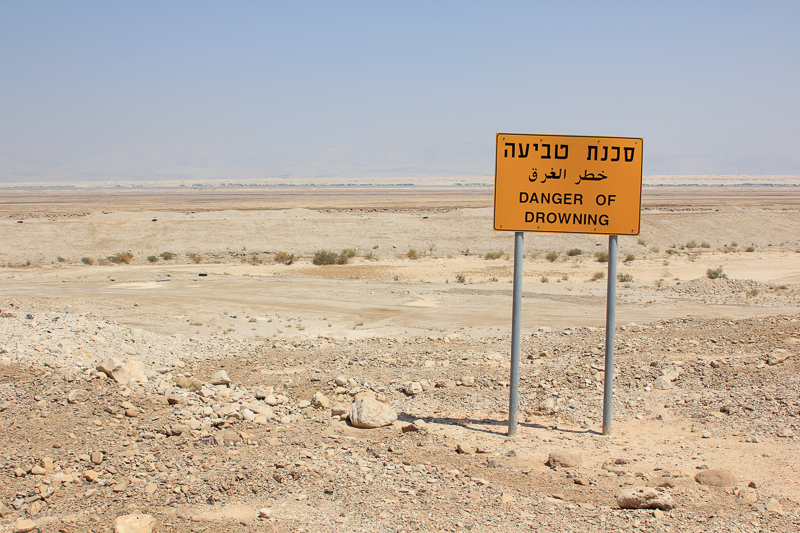
It’s no longer accurate to call it the Dead Sea.  The sea level is dropping a meter a year, and has now broken into two distinct sections.  What a wonderful environmental disaster it has become, and a great spot to stop for a bit of a swim.  I halted at a place near Ein Gedi, which also had a true desert oasis which I completely missed because I was too intent on watching Russian matrons float like Beluga. For man of the Russians, the real joy here was they could float and smoke at the same time.

From Ein Gedi’s original beach area you have two options to get to the sea.  You can walk to the new shoreline, or take a makeshift train.  It’s the sort that drags families around amusement parks.  When you’re standing at a sign that says “Shoreline: 1985” it seems silly to do anything but walk, so I did.   It seemed even hotter there than at Masada, but I was going to a beach, and planned to cool down in the water.  After baking under the sun for about ten minutes I came to a well-constructed wooden deck that at some point had been the new beach area.  No signs of water.  I kept going.  I came to a shower facility used to get the salt off your body when you’re done swimming.  I kept going.  I passed a sign that said “Shoreline: 2000”.   See where this is going?   Finally I came to the new, new wooden deck area, stepped off, and kept going.  The Dead Sea will not be of this world much longer.  It took fifteen minutes of walking, before I’d finally reached the beach, and it is a beach from hell.  It is not sand, but salt.  And I don’t mean salt like.  I mean actual salt.  This is not an exaggeration.  You can reach down, scoop up a handful and sprinkle it on your fries.  The spa which controls beach access demands you wear footwear when going near the water.  This is because natural salt is not soft.  It is sharp and jagged, and if you’re not careful will slice your feet apart.  This brings up a minor inconvenience of with the water.  The ocean has about 3.5% salinity making it unpalatable, and deadly if you drink too much.  It’ll also stings your eyes.  The Dead Sea is currently at around 35% salinity, ten times higher.  This isn’t water anymore.  It’s a giant chemistry experiment.  I tasted the water and felt my tongue string.  It is poisonous even in low quantities.  Before swimming they warn you if you have any cuts, or get water splashed on yours eyes, that it’s going to burn.  What they don’t warn you is that it will burn any opening, or openable, part of your body.  Any.  So you sit in the water, which is Jacuzzi hot, bobbing like a cork, and hoping the stinging pain goes away because you really don’t want to be the first one to run out, holding yourself, and whimpering.

Israel 338

Now the really cool part about the Dead Sea is that you really do float.  In general, I tend to sink.  Not here.  A person cannot sink.  I doubt a brick could sink.  It’s impossible to get your entire body underwater at one time.  It’s as though someone took a bicycle pump and had a go at turning you into a balloon.  Stick your leg down, and it floats back up almost instantly.  Stick your legs out, and you tip backwards.  Put your head back, and it’s like there’s a pillow there.  When I finally manage to get myself upright, I floated up out of the water close to my nipples.  It really is a remarkable experience once you get over the pain of salt sneaking its way into ever orifice.  One local described it like swimming in soup.  That’s about right.

I rinsed off, trudged back to the spa, and then was on my way back to Tel Aviv, driving below heavily guarded settler communities atop the barren hills.  It’s almost Sunday, and it seems I’m expected me to work on this trip…

Jerusalem and dates

Jerusalem is nothing like Tel Aviv and it’s far more interesting for it.

This past Friday was the first one of Ramadan, and the Israeli’s expected trouble.  I awoke just before six, by which time thousands of additional police and Para-military were already setting up checkpoints and roadblocks in an effort to control access into the old city.   The first group took up position outside the walls, re-directing traffic and blocking off many of the streets that lead to the old city’s main gates.  Passing through East Jerusalem, my driver was able to get me to the City of David, which is just south of Dung gate, outside the present walls and the only entrance directly onto the Wailing Wall.  Today, it’s one of only two into the Jewish Quarter itself.  Jerusalem has a wildly complex history, and without a good set of maps it’s almost impossible to figure out the different bits that were, are, or might be, part of the old city.  Briefly, much of what is today within the walls, was just goat pastures when a rather self-assured young carpenter started telling people to stop hitting each other with sticks and worship him instead.

Even though now outside the walls, The City of David is the oldest part of Jerusalem and holds a strong allure for Israelis.  If there was a  King David, this is likely where he lived.  (The jury is out on that one though.  Other than the Bible, there’s scant reference to David.  A single Aramaean fragment might say “House of David”, but is also might say “House of Kettle.”  The City of Kettles, doesn’t have the same ring to it.)  The most impressive feature is Hezekiah’s tunnel which cuts through bedrock to provide an underground, and hence secure, channel for water to flow into the city.  The Hong Kong tour group in front of me was all giggles.  Having arrived before it opened, and I tend to migrate away from the most heavily trafficked areas, I decided to head down the hill, and out into the streets below.  As it turns out, I was at the edge of Silwan, a Palestinian village, and now a trouble spot as Jewish settlers push in.  The settlers use a variety of methods to buy up, or have demolished, Palestinian houses, and then take the land.  The differences are stark as you begin to notice clusters of houses with Jewish flags, better maintained exteriors, and armed guards.  As I explored, a local settler passed me, dressed in traditional black, carrying a shopping bag, and with a pistol shoved into the back of his pants.  It’s remarkable to me that some would choose to live this way.  So although things were calm while I was there, there was plenty of evidence of the potential for violence.

At the end of one street, where a row of Jewish houses thrust deeper into Silwan, I noticed a Jewish security guard up the hill watching me intently…or at least I had thought it was me he was watching.  A few minutes later a small blue bus pulled up below me, and a rather stern security guard from the bus jumped out and took up position.  Khaki pants, polo-shirt, equipment vest, and just generally far too many pockets.  A Jewish boy, perhaps twelve, emerged from up the street and hurried down to the awaiting vehicle.  He said something to the guard while pointing towards the Palestinian area.  The guard did not reply, his eyes never leaving the Palestinian street as he simply nudge the boy into the bus.  With the boy safety aboard, the bus backed-up, and drove off to a day of recess and pulling girls’ hair.  We had guards on our busses where I grew up as well, but they were local military recruits, and I doubt gave a hoot what happened to us.

Walking back up the hill into the Jewish area, I noticed for the first time two different lookouts built atop buildings.  The first was manned and keeping a careful eye on the Palestinian buildings just across a small dry stream bed.  The second looked like it had been thrown together in haste, perhaps during the last Intifada.  Nice life, huh?

Israel 069

The second group of extra police positioned themselves near the Wailing Wall.  There is a large, modern ramp the runs up on one side of the Western Wall and ends at a small gate that opens onto the Temple Mount itself.  Muslim’s don’t enter that way, and would certain not use it to leave, which leaves its purpose open to speculation, but the evidence points to security.  It’s covered, so you can’t see what goes on in there, but I happened to catch a glimpse of a platoon of heavily armed police snaking their way up to take position just behind a gate at the top.  In case the prayer services ends in something of a riot, I figure, its looks like they’re ready to spill onto the Temple Mount and take control.

Jerusalem is broken out into four distinct quarters, though the distinction blurs a fair bit at the seams.   The Jewish Quarter, substantially destroyed in ’48 after the British washed their hands of the entire place, was extensively rebuilt and repopulated after the six-day war in ’67.  It’s clean, orderly, and generally where tourists go to buy Gelato and not worry that they’re wearing a Cheney for President t-shirt.  A great deal of archeology has been done in this section, revealing numerous ruins, all destroyed during the Roman sacking of the city in 70 A.D., the event which arguably birthed the main problem the Middle East is still dealing with today.  The fires which roared through the city left soot and scorch marks on floor mosaics which you can still see today.  In one home they found a spear and severed arm, and next to those, charred wooden beams from the ceiling.

Israel 205

The Christian and Muslim quarters are similar to one another, but you find more tourists venturing into the Christians areas.  Both quarters are a maze of congested alleys jammed with all manner of tiny shops hawking their goods.  Very little natural light makes it in.  The main alleys are illuminated by exposed blubs hanging from makeshift wires strung above.  As you head deeper into the Muslim area, the tourist trinkets give way to shops full of spices, skinned goats, and women’s underwear.  It’s here that a better part of East Jerusalem does its shopping.  You also soon notice that unlike in the Christian areas, the number of tourists has dropped off substantially, and native speakers of English are almost extinct.  It’s left to a few intrepid Europeans to venture this deep.  The area is poorly kept, and the smaller alleys which lead away from the main thoroughfares are less than welcoming.  Unlike the Jewish Quarter with its signs reminding people that you’re walking through a family neighborhood, so please be respectful, here packs of local kids seem to live a Lord of the Flies like existence, like something from a grade school teacher’s nightmare.  In one alley I found a group charging about with flaming torches, laughing as they spun the torches wildly, letting the embers fly off and burn their friends.  Kids and their games.  The Armenian Quarter is the smallest of the four, and really just amounts to a few anti-Turkish posters up on a wall.

Israel 185

What seems like the largest contingent of police took up position in these alleys, particularly the ones leading to Al Aqsa mosque, but unlike our riot police who stand in long rigid lines with visors down, these leaned up against walls, chatted, and generally looked as though they didn’t have a care in the world.  No doubt the moment something went wrong they would have gotten to the business of violating human rights, but for now it went a long way to keeping the atmosphere from being explosive.  Unfortunately, as a result of their presence I couldn’t get very close to the Temple Mount.  As I tried to follow the worshipers, an officer stopped me, and pointed me to a different route, one leading away.  To keep a lid on tensions, even the area leading to the Temple Mount was bared to non-Muslims, and apparently I stood out as one of those.  Must have been my shoes.  Later in the day, after prayers were over, a reverse flow began as the city once again emptied of Muslim worshippers.  It is like watching the tide,a hungry tied waiting for the sun to set so they could feast.

Israel 190

There are a number of observational points in the Jewish quarter that look down at the Wailing Wall.  These are typically well policed.  There’s also a much bigger one right above on the Temple Mount itself, but rather than being observational, that one’s typically used for throwing stones at the Jews below.  In the afternoon, as I was getting ready to head back to the hotel, I came across a young group of French Jews who were obviously making a pilgrimage to the city.  They were at one of the observational points, carrying a large Israeli flag, and oddly two of their group were blindfolded.  That sort of thing never bodes well in the Middle East, and typically ends up on a Jihadist version of YouTube, but the two police nearby didn’t seem terribly concerned, so I stood about and watched.  Their guide went through a dramatic speech full of emotion and obviously designed to build excitement.   As he neared the climax he held up a radio and played the voice of Mordechai Gur from ’67, announcing that his men had just taken the Temple Mount.  It was all very theatrical and obviously designed to build a certain level of expectation.  Then with a final flourish off came the blindfolds, and the students saw the wall for the first time.  The first of the two turned, face blank, mouth slightly open.  I’m not sure if it was a look of awe, disappointment, or excitement so far off the dial his facial muscles just gave up and sagged.  They sang, they clapped, and they wandered off, perhaps to find the Gelato.

Israel 134

I bought a late lunch in the Muslim Quarter (Dates, bread, and an amazing form of baklava with a custard layer), then headed out through the Damascus gate on my way back to the hotel.  Damascus Gate is chaos in motion, a collision of roads, people, and goods that can be heard for miles away.  It’s easy to slip back in time there and I’d like to go back, perhaps this time with earplugs.

Israel 210

Just past the gate, and run by the most cordial British Protestants, is the Garden Tomb, which many believe to be the actual site of both the crucifixion and burial of Christ, rather than the Church of the Holy Sepulcher within the Christian Quarter.  Although archeologists have mostly debunked this idea, in typical British fashion the volunteer guides point out that, “well, yes, that might be so, but wouldn’t it be ever so nice if it were true?”  And then, with pleasant smile, “Did you know the garden has the 3rd largest cistern in Israel?”  After a long day, it’s an ideal spot to find a little bench and sleep.

The expected violence never arrived, at least not this time.  Local commentators point out that with the PA doing a reasonable job of maintaining order, jobs are the biggest issue in the West Bank now.  Gaza, rockets, and pushing the Jews back into the sea will have to wait.  As for the border with Lebanon, now that’s where there’s going to be another war, as early as later this summer, if the pundits are to be believed.

Saturday it’s the West Bank, Masada, and the Dead Sea.   If I can float anywhere, that’s the spot.

Soldiers, Breasts, and Flip-Flops

Never stay in a hotel that’s located between two major highway off-ramps.  Also, if you’re looking for your hotel on Google earth, and there’s a large blank spot where it’s meant to be, a spot into which roads just seem to disappear, a spot which itself doesn’t even officially exist, you’ve chosen a hotel right next to the Israeli Ministry of Defense, which makes finding your way around rather difficult.

Israel is a strange country to fly into, almost as though you’re flying into a walled fortress with enemies on all sides. Thirty minutes out you are told to stay in your seats for the remainder of the flight.  Israel invented airline security. The plane approaches from the west, from over the Mediterranean, flies low over a military base, and then banks hard to come back around from the east.  I suppose if you didn’t bank hard you’d end up somewhere near Damascus watching a vapor trail racing upwards.  The Israeli desire to keep the West Bank becomes very clear.  This is not a terribly wide country.  And neither are its people.  As my room service waiter said, “Israeli women are hotties, but don’t try a one night stand because they’re demanding, especially the Moroccan ones.”   That’s why he’s divorced now.  He thought Italian woman were hot too, but realized they were “dogs compared to Israeli women.”  Important advice, I suppose, I just wish he’d remember to bring up my fruit plate.

What to think about Tel Aviv?  There are places you love immediately, places you grow to love, and places you fear something is going to love growing on you.  So far Tel Aviv is somewhere between the latter two.  It’s a chaotic mixture of southern Mediterranean neglect and modern prosperity.  There are newly built glass towers interspersed between rundown buildings with mildew stains streaming down from cracked stucco.  The big Latin American cities come closest in atmosphere, but Tel Aviv’s air is cleaner, it’s skyscrapers taller, and there’s no one out to kill you, well, not just you.  And cats.  Everywhere cats.  They’re as common as squirrels here.  It’s also remarkably secular, even though some 95% of its inhabitants consider themselves Jewish.  I finally spent some time today walking around the city and other than a few skull caps, and a Hassidic man praying up against a wall at the beach while a bikini clad Moroccan lady showered off sand nearby, it could have been any prosperous European city along the Mediterranean with attack helicopters flying watch.  Montreal has a more overtly Jewish population than Tel Aviv.

I suppose if you came into Tel Aviv from almost anywhere else in the region, and even big parts of Europe’s Mediterranean coast, Tel Aviv really is an impressive city.  It’s alive at all hours, full of people walking the streets to see and be seen, and most with a liberal view of life.  On my first night, at three AM when I was fighting jet-lag, I caught a documentary on gay Palestinians who flee the West Bank to live in Israel proper where they aren’t persecuted.  What a complex little place this is. I’ll give it some more time before I decide what I really think.

Curiously, despite the history of car bombs, suicide bombers, and surprise invasions, I do feel very safe here.  Perhaps it’s the hundreds of young female military recruits in olive fatigues and flip-flops coming out of the ministry each evening, talking on their cell phones, doing their make-up, and holding shopping bags from lunchtime excursions.  They make me feel safe until I realize the ones who serve at the ministry are those who couldn’t pass their physical to get out to the combat units near the border.  After that I just feel aroused.

Perhaps after you’ve passed through your hundredth security checkpoint, where some sleepy guard waves a wand over your shirt and passes you through despite the fact that his wand beeped, you just don’t notice it anymore.  Even standing behind a solider holding his M4A1 assault rifle in one hand, and a bag of bananas in another, I’ve stop noticing it all that much.  I travel to Jerusalem in a few days. Maybe it will be different.  Incidentally, if I ever had a son here, I’ll tell him to fail that damn physical and spend his next three years at the ministry with the girls in flip-flops.

Tomorrow before work starts, I’m off to a little place called Apollonia.  It’s on the coast, just a five minute walk from my temporary office in Herzeliya.  It was founded by the Phoenicians, and then occupied by Romans, Byzantines, Muslims, Crusaders, Muslims again, Brits, and now Israelis.  Plenty of history around here.